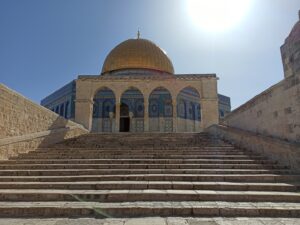
The Western Arches

Audio Narration
Landmark Location:
Located across the door of the western rock toward Bab al-Mutahra.
Landmark Location relative to Dome of the rock:
Located in the middle of the western boundary of the Dome of the Rock.
Landmark History:
Built during the Umayyad period, in 340 AH – 951 m.
Builder Name:
Renewed at the time of Enthkine Ghuri Fatimid.
Details of the shape:
-They are two great knees in the ends, and three columns Cylindrical in the middle, with twenty-four stairs, for whoever wants to climb The Rock Bowl from the Square of the Western Mosque.
-Directly to the west of the Rock, toward Bab al-Mutahrra, which is close to the Dome of the Rock.
-They extend to the Rock’s nave. They are considered comfortable to climb. They consist of four entrances.
-The origin of the arches goes back to the Umayyad period, and they were mentioned by Ibn al-Faqih and Nasser Khasrow.
An Overview of the Landmark:
The Western Arches consist of two huge rocks and 3 cylindrical pillars in the middle. They have 24 steps that lead to the Rock’s nave from the western court of the mosque. They are located in the middle of the western side of the Dome of the Rock, which is right in the middle of Al-Aqsa Mosque. Their current structure was built in 951 (340 A.H.). they were renovated during the time of the Fatimid Anoshtikin Al-Ghouri. Also they were renovated in the Ottoman era. They are right across the Rock’s western gate. They reach the middle of the Rock’s nave, near Al-Mutaharah Gate. Hey are considered easy to climb. They consist of entrances. They date back to the Umayyad era. They were mentioned by Ibn al-Faqih and Nasser Khasrow. They were covered with concrete and some drawing were painted on them. We can still notice the concrete in their southern side. During the early Islamic time, Al-Khader site was near the middle west arch. In the Ayyubid or Mamluk era, it was moved near the northwestern arch. They were renovated during the time of the Fatimid Anoshtikin Al-Ghouri, and then once again in the Ottoman era.