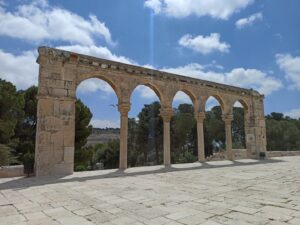
The Eastern Arches

Audio Narration
Landmark Location relative to Dome of the rock:
The eastern edge of the Rock’s nave.
Landmark History:
Probably established in the Umayyad era, rebuilt in the Abbasid period, in the tenth century AD – the fourth Hijri.
Builder Name:
The Umayyad and the Abbasids renewed them.
Details of the shape:
-The largest of the boulders around the Rock’s nave, where it consists of two great arches, four cylindrical pillars of marble, connect the courtyard of the mosque eastern Rock’s nave with twenty-two Stairs, and three other degrees, height 6.5 m.
-Overlooking the western slopes of the Mount of Olives and its ramparts on stones, no inscription on.
-Mentioned by Nasser in his visit to Jerusalem 438 AH / 1047 AD where he said: ((Also on the eastern side a great road similar, Columns above it are hoops and a balcony and is called the eastern shrine, Al-‘Umari points out that the two approaches, from its five entries, closed and remained until 1945 when the Council the Islamic Supreme Council opened all the entrances and reconstructed the stairs that had become of twenty-five Stairs instead of thirty-six Stairs of Al-‘Umari age.
An Overview of the Landmark:
The Eastern Arches consist of two huge rocks and 4 marble cylindrical pillars. The reach the eastern court of the Rock’s nave, by 25 steps. They are 6.5 meters high. They are located in the eastern end of the Rock’s nave, which is in the middle of Al-Aqsa Mosque. They were probably built in the Umayyad era, and rebuilt in the Abbasid period, in the 10th century, that is the 4th Hijri century. They are the largest arches around the Rock’s nave. They overlook the western slopes of the Mount of Olives and its ramparts on stones, no inscription on them. They were mentioned by Nasser Khasru in his visit to Jerusalem 438 AH / 1047 AD, where he said: ((Also on the eastern side a great road similar, Columns above it are hoops and a balcony and is called the eastern shrine, Al-‘Umari points out that the two approaches, from its five entries, closed and remained until 1945 when the Council the Islamic Supreme Council opened all the entrances and reconstructed the stairs that had become of twenty-five Stairs instead of thirty-six Stairs of Al-‘Umari age.