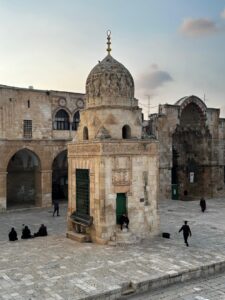
Qayt Bay Spring
Audio Narration
Landmark Location:
In the face of Bab Al-Mtahra next to the road leading to the western staircase to the
rock.Landmark Location relative to Dome of the rock:
In the western side of Qubbat Al-Sakhra, dome of the rock.
Landmark History:
In the Mamluk period in AH 859 / AD 1455, the building was rebuilt in 887 AH / 1482 AD. The building was renewed in 1300 AH / 1882 AD
Reason of the name:
In relation to the Mamluk Sultan, Ashraf Qaitbay, who ordered the rebuilding of the spring.
Builder Name: The Mamluk sultan, Inal Sabila, was rebuilt by the Mamluk Sultan Al-Ashraf Qaitbay. Then the new spring in the era of the Ottoman Sultan Abdul Hamid II.
Details of the shape:
-High and beautiful, height of 13 meters and the width of the base square 4.5 meters opened three large windows to provide water as it ascends to degrees and on the west side is the door of the spring.
-It was used in the construction of colored stones in what is known as Al-Mashhar or Al-Ablaq. It has a beautiful stone dome decorated with floral motifs from the outside. It is the only one in Al-Aqsa Mosque, which is decorated from the outside.
-One of its aesthetics is the fact that it did not move from square to dome directly in contrast to the shallow Ottoman domes, from square shape to triangles.
Additional Information about the landmark:
-On the spring there is a large terrace with a stone niche dating back to the Mamluk period.
-Below the spring there is a large well-watered well that extends to the western gallery of Al-Aqsa length of 28 meters and width 6 meters and depth of 11 meters and a half meters.
-There is an exquisite book that chronicles the sultans who live the way and explains the purpose of building the spring and a verse of the Holy Quran.
-In 140 AH / 1981 AD. Zionist excavations were found stretching from west to east under Bab Al-mtahar and implemented to the well for a length of more than 25 meters inside the courtyards of Al-Aqsa Mosque and not separated only a few meters from the Dome of the Rock in Al-Aqsa Mosque and still pass through two sets of faucets In its southern and northern regions.
An Overview of the Landmark:
It is In the face of Bab Al-Mtahra next to the road leading to the western staircase to the rock. In the western side of Qubbat Al-Sakhra, dome of the rock. The Mamluk sultan, Inal Sabila, was rebuilt by the Mamluk Sultan Al-Ashraf Qaitbay. Then the new spring in the era of the Ottoman Sultan Abdul Hamid II. In the Mamluk period in AH 859 / AD 1455, the building was rebuilt in 887 AH / 1482 AD. The building was renewed in 1300 AH / 1882 AD
High and beautiful, height of 13 meters and the width of the base square 4.5 meters opened three large windows to provide water as it ascends to degrees and on the west side is the door of the spring.
It was used in the construction of colored stones in what is known as Al-Mashhar or Al-Ablaq. It has a beautiful stone dome decorated with floral motifs from the outside. It is the only one in Al-Aqsa Mosque, which is decorated from the outside. One of its aesthetics is the fact that it did not move from square to dome directly in contrast to the shallow Ottoman domes, from square shape to triangles. On the spring there is a large terrace with a stone niche dating back to the Mamluk period. Below the spring there is a large well-watered well that extends to the western gallery of Al-Aqsa length of 28 meters and width 6 meters and depth of 11 meters and a half meters. There is an exquisite book that chronicles the sultans who live the way and explains the purpose of building the spring and a verse of the Holy Quran. In 140 AH / 1981 AD. Zionist excavations were found stretching from west to east under Bab Al-mtahar and implemented to the well for a length of more than 25 meters inside the courtyards of Al-Aqsa Mosque and not separated only a few meters from the Dome of the Rock in Al-Aqsa Mosque and still pass through two sets of faucets In its southern and northern regions.
v