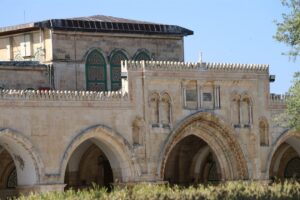
Al-Masjid al-Qiblī

Audio Narration
Landmark Location:
South of Al-Aqsa Mosque, towards the Qibla.
Landmark Location relative to Dome of the rock:
South of the Dome.
Landmark History:
86-96 e / 705-714.
Reason of the name:
Named “AlQibli” because it is located towards the Qibla. Named the Al Jamea mosque, because it is the main prayer hall where men gather behind the imam.
Builder Name:
Calipha Abdul Malik bin Marwan, and completed by his son Walid bin Abdul Malik.
Details of the shape:
-Rectangular, roofed building with a 78–meter-long and 52-meter-wide bullet proof dome. It consists of 7 long corridors extending from north to south of the mosque, and other 7 corridors extending horizontally from the east of the mosque to the west, and the middle corridor is a wider corridor, roofed with Ghamlouni, decorated with Arabesque art. Also, there are Salah al-Ddin mehrab, and the menbar of Noor al-Din, and above them is the dome of the oratory, which is 23-meters-high.
-It can accommodate 5,500 worshipers, with eleven doors in the north, two in the west and one in the east, and an area of about 4 acres.
Before you enter the prayer hall from the north, you will see an open yard in front of the seven gates of the hall, consisting of seven pointed arches mounted on stone pillars, on the top of this yard are gears that stabilize many inscriptions that date many architectural works that have been carried out in this yard.
-At the eastern side of prayer hall, there are many rooms:
1 – Iwan Mihrab Zakaria: a small room semi-square dimensions (5 * 4.6) decorated mihrab, dating back to the Mamluk period, with the first verses of Surat Maryam.
It is rumored that it is one of the Crusader additions to the prayer hall, but later an inscription, discovered by Seljuki, confirms the existence of the room before the Crusader occupation.
It also received a symbolic name that does not refer to the place where Mary and Zacarias worship peace.
2– Iwan the Shrine of the Forty: Located in the eastern side of Al-Qibli prayer hall to the south of the mihrab of Zakaria, attributed to the forty men buried in the of Mount Qasion – Damascus, with width of 5 m and length of 8 m and an estimated height of 8 m, the Iwan is connected to Omar Mosque via a door, it is small on the southern side of the Iwan and has no mihrab, It is likely from crusader additions to the prayer hall but modified in the Ayyubids period and added verses of Sorat Al Isra’a.
3 – Omar Mosque: Located east of Al-Qibli prayer hall from the direction of the Qibla, which is a room rectangular shape, partially cut and dedicated as a medical clinic to the mosque.
It contains a mihrab in the middle of the southern wall of Al-Aqsa Mosque and on one line with a dome, the chain that occupies the middle of Al-Aqsa Mosque and this means that the Calipha Umar ibn al-Khattab established the mihrab on this place.
Additional Information about the landmark:
-It is common that people consider Al-Qibli prayer hall as THE Aqsa Mosque, and this poses a great danger to Al-Aqsa Mosque and works to divide it. In fact, Al-Aqsa mosque mentioned in the Holy Qur’an is not only Al-Qibli mosque or the Dome of the Rock, since they both were not built at the time of Qur’an Revelation, rather everything inside the wall.
-What had Al-Qibli prayer hall been called before it was called Al-Aqsa?
Ancient historians named several names on the covered prayer hall as the mosque and the mosque Qabali in which the mihrab and named the prayer and other names. However, the matter is not clear to the people, and they stopped calling the whole area “Al-Aqsa” ans started calling Al-Qibli prayer hall by that name, and they named the area as “Haram Al Qodsi” Or “Haram al-Sharif” .
The traveler Nasir Khusraw was the first to pass this information about this name after his visit to Al Aqsa mosque.
-What is the reason for naming Al-Haram al-Sharif on the prayer halls and all mosque squares?
May be a fear of confusing Al-Qibli prayer hall and the blessed Aqsa Mosque, perhaps the period that followed the first Ayyubids liberation prevented non-Muslims from entering it similar to the Haram al-Makki and Medina, However, Muslim scholars warned against saying the word “Haram” on Al-Aqsa Mosque, fearing of applying the provisions of religious sanctuary on it.
-The Zionist entity claims that Al-Aqsa Mosque is the only Al-Qibli prayer hall and a dome building the Rock is a memorial building, and the yards of Al-Aqsa Mosque are public yards subject to the laws of the municipality of the entity – such as non-observance of the sanctity of the mosque and non-condescension, all this for preparation to the Judaization in full.
Al-Qibli Prayer Hall in the Umayyad period:
-Calipha Abdul Malik bin Marwan AlUmawi initiated the construction of Al-Qibli prayer hall and it was completed by his son Waleed, after the death of his father, the most important work completed by Alwaleed is the marble cladding and mosaics.
At the end of the Umayyad period in 747 AD, *Jerusalem wa