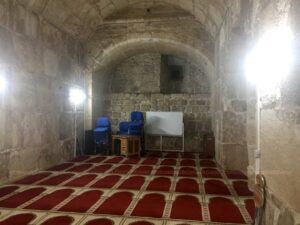
Bab Al Thulathi (The Triple) Gate

Landmark Location:
In the southern wall of the Al-Aqsa Mosque wall.
Landmark Location relative to Dome of the rock:
East South Dome of the Rock.
Landmark History:
At al Umayyad time most probably during the reign of Abdul Malik bin Marwan.
Reason of the name:
In the past, it was named “the triple Gate” because it consists of three gates.
Builder Name:
The Umayyad (Abdul Malik bin Marwan).
Additional Information about the landmark:
-These gates served the Islamic neighborhoods located south of the mosque where the gates were 3 times long (similar to the Double Gate corridors) under the level of the mosque leads to its yards.
Closing the Gate:
There is a common saying the Gate closed after Salahaddin liberation, and has circulated information about all closed Gates, However, there is no historical evidence to support this Saying.
Proof of inaccuracy:
-At the hadith of Ibn al-‘Umari about the Marwani chapel in 755 AH–1354 AD mentioned the opened Gates which was leading to the area of Silwan and was intended triple Gate in 746 AH – 1345 AD.
-The Marwani chapel was reached until the year 900 AH – 1495 AD from outside the wall, from the triple or single Gate as indicated by Hanbali.
-During excavations in the Umayyad region, the wall of Ayyubi revealed in front of the closed gates indicates that the Ayyubies protected the gates by building a wall in front of them, but not closing them as believed, It is more likely that the triple and single Gates Completely closed after the rebuilding of the wall at the time of Sultan Suleiman at the beginning of the Ottoman period.
-After the Zionist occupation of Jerusalem in 1967 AD:
-Following the failure of Jewish excavations in the area of the Umayyad palaces south of the Al-Aqsa Mosque to proving any right to the Jews, they claimed that the triple Gate (as well as the Double Gate) one of their claimed Temple and called them the “Gate of Khaldah”, claiming that they discovered the remains of a staircase from the second temple, leading to them, took it as an excuse to build a stone staircase along part of the barrier south of Al-Aqsa, and specifically in the area between the triple and Double Gates.
-The Muslims were alerted to that the attempt aimed at capturing the Marwani chapel and the old Aqsa Mosque and turning them into Synagogue to find a place for the Jews within Al-Aqsa Mosque, but thanks to God that the Muslims were able to reduce that danger through the work of restoration of the worshipers.
At 2001:
Because of excavations, part of the southern wall of the Al-Aqsa Mosque buckled between the triple and the single Gates, with a length of about thirty meters, and this was the most intense eruption over the rebuilding Aqsa Mosque since the occupation.
An Overview of the Landmark:
It is three adjacent gates in the southern wall of the wall of Al-Aqsa Mosque, 50 meters from the single gate, 80 m from the Double gate, overlooks the emirate’s house and the existing Umayyad palaces south of Al-Aqsa, lead to the western wall of the Marwani Chapel located inside Al-Aqsa Mosque Al-Mubarak, located east of the Dome of the Rock, Umayyads built it to reach the chapel located under the southeast corner of the Al-Aqsa Mosque, which known as the eastern settlement.
The gates served the Muslim neighborhoods of the mosque complex where the gates had three long corridor (similar to the Double Gate corridors) under the level of the mosque leads to its yards.
Closing the Gate:
There is a common saying that the Gate closed after Salahaddin liberation, and popularized on the other closed Gates, but there is no historical evidence to support this statement.
Proof of inaccuracy:
In the speech of Ibn al-Omari about the Marwani chapel in 755 AH-1354M mentioned opened Gates leading to the area of Silwan intended triple Gate in 746 AH – 1345 AD.
The Marwani chapel reached until the year 900 AH – 1495 AD from outside the fence from the triple or single Gate as pointed out by Hanbali.
During the excavations at Umayyad region, the wall of Ayyubi revealed in front of the closed gates. This indicates that the Ayyubids protected the gates by building a fence in front of them but not closed them, as believed.
It is likely that the triple and single Gates completely closed after the reconstruction of the wall at the beginning of the Ottoman period.