

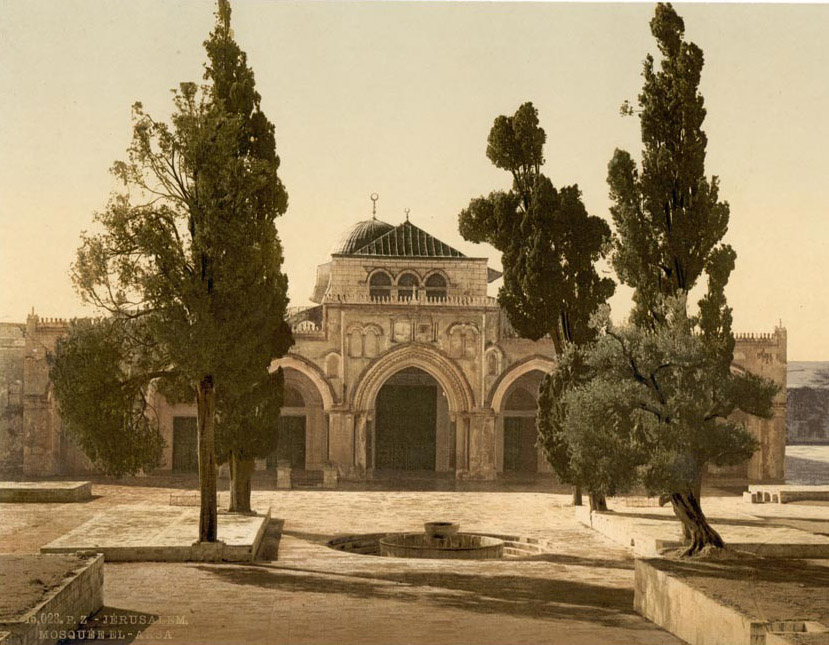
Al-Masjid al-Aqṣā During the Crusader Occupation
Al-Masjid al-Aqṣā During the Crusader Occupation (1099–1187 CE)
The eighty-eight-year period during which the Crusaders (the Franks) held Jerusalem under occupation represents one of the darkest and most tragic chapters in the history of Bayt al-Maqdis, and especially of the blessed al-Masjid al-Aqṣā, following the glorious days that began with its conquest by the Muslims in 16 AH / 636 CE.
From 1099 until 1187 CE, Jerusalem remained under Crusader control. During this period, Muslims were prohibited from performing ṣalāh in al-Masjid al-Aqṣā, which was converted into the headquarters of the occupying European forces.
The Crusader armies set out from Europe under the encouragement of churchmen and with the stated aim of “liberating” the Holy Sepulchre from Muslim control. However, the economic ambitions and colonial aspirations of those leading the campaign were too transparent to be concealed beneath their religious rhetoric. Exploiting the severe weakness caused by the infighting among the Muslim emirates and petty states, these forces — described by some chroniclers as little more than a mob led by European princes and knights — invaded the lands of Islam.
After capturing many cities in Syria and establishing Crusader principalities, the Franks reached Bayt al-Maqdis, then under Fāṭimid control, and laid siege to the city. Following a siege of forty days, they breached the walls in 1099 CE (497 AH) and stormed the city. According to Crusader chronicles themselves, for three days they massacred both the city’s inhabitants and those who had sought refuge within its walls. The streets and squares overflowed with corpses, and in some accounts the death toll is given as approximately seventy thousand.
Even those who had sought sanctuary in al-Masjid al-Aqṣā, hoping that the sanctity of the site would protect them from slaughter, were not spared. Thousands of innocent men, women, and children were massacred inside the mosque. Both Muslim and Crusader sources record these events in detail.
Modern histories of the First Crusade summarize the events as follows:
“The Crusaders killed everyone they encountered until they reached Solomon’s Temple (al-Masjid al-Aqṣā). Such a great massacre took place that the blood of the slain reached up to the ankles of our men…”
The Crusader chronicler Raymond of Aguilers adds in Historia Francorum qui ceperunt Iherusalem:
“The atrocities suffered by the people of Jerusalem in the streets and squares were nothing compared to what happened in Solomon’s Temple (al-Masjid al-Aqṣā). And what happened there? The truth is beyond your ability to comprehend, so let it suffice to say this much: our men rode in blood up to their knees and the bridles of their horses. Truly, it was the judgment of God that this place should be filled with the blood of the unbelievers, for Jerusalem had suffered much because of their blasphemies. The city was filled with corpses and blood.”
Similarly, the contemporary historian Fūshiyā al-Shartārī writes in The History of the Campaign of Bayt al-Maqdis:
“Some fled to the Temple of God and the Temple of Solomon. A fierce battle raged in the courtyard and around it. There was no escape for them from our warriors. Many fled into the courtyard of Solomon’s Temple, where arrows rained down upon them until they fell dead. Nearly ten thousand were massacred within the sanctuary. If you had been there, you would have seen that our feet were immersed up to the ankles in their blood. None of them survived — not even the women and children.”
He also reports that large quantities of gold, silver, and precious stones found in al-Masjid al-Aqṣā were plundered by the Crusader commander “Tancred.”
The Muslim historian Ibn al-Athīr records concerning these events of 492 AH:
“The Franks massacred more than seventy thousand people in al-Masjid al-Aqṣā, including the imams, scholars, ascetics, and worshippers of the Muslims. Some of them had left their homelands to reside near this noble sanctuary.”
He also provides details of the treasures looted from the mosque, stating that from the Dome of the Rock (Qubbat al-Ṣakhrah) alone, more than forty great lamps, each weighing 3,600 dirhams, were taken, along with approximately one hundred and fifty small lamps and over twenty golden lamps. He concludes:
“They seized so much wealth that it cannot be enumerated.”
Those whom the Crusaders did not slaughter were forced to clear the streets of corpses, including the courtyards of al-Masjid al-Aqṣā, before the Crusaders began to reoccupy and repurpose the sacred site. They undertook several measures to transform al-Masjid al-Aqṣā into a Crusader shrine and military base:
- King Baldwin of the Crusader Kingdom of Jerusalem converted the Qibli Mosque into his royal residence.
- After moving his residence elsewhere, he granted the mosque to the Knights Templar, an order of militant monks known for their radical religiosity. They altered the mosque’s symbols, destroyed its decorations, partitioned its halls, and converted its sections into a church, living quarters, storerooms, and an administrative headquarters.
- The Dome of the Rock was turned into a church named Templum Domini (“The Temple of the Lord”). Its Islamic decorations were defaced or replaced with Christian imagery and statues, and a large golden cross was erected on its summit.
- The Marwān Mosque, located in the southeastern corner of al-Masjid al-Aqṣā, was converted into a stable for their horses. Its columns were pierced to tether animals — and ever since, many Western sources have referred to it as “Solomon’s Stables.”
- The Dome of the Chain (Qubbat al-Silsilah) was converted into a chapel.
- The Crusaders began building a church in the open courtyard of al-Masjid al-Aqṣā, though it was never completed.
- On the western side of the mosque, they built an armory and storehouse for weapons and provisions.
This period also witnessed priests chiseling off pieces of the Rock (al-Ṣakhrah) inside the Dome of the Rock, selling them to pilgrims as relics at the price of gold, so that they could take them back to their lands as blessings. When the Crusader king feared that the Rock would be completely lost if this practice continued, he ordered it to be encased in marble and surrounded by an iron grille — a measure that remains visible to this day.
This state of desecration and occupation persisted throughout the entire eighty-eight years of Crusader rule over Jerusalem, until 583 AH / 1187 CE, when Sultan Ṣalāḥ al-Dīn al-Ayyūbī (Saladin) and his army of mujāhidīn liberated the city, restoring al-Masjid al-Aqṣā to its rightful Islamic identity.